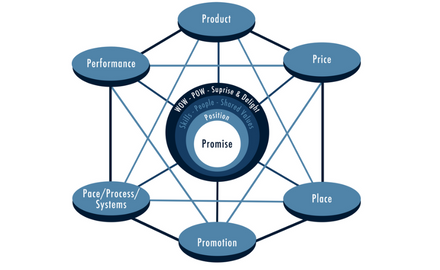
…than lower level recommendations and these trusted sources are typically friends or family members., reports McKinsey.
Three key telegrams from McKinsey’s word of mouth report are that WOM recommendations drive 20% to 50% of all purchases; influentials make up about 9% of the population and drive about 3X more WOM; and, the payout of pursuing WOM excellence is enormous, delivering a huge competitive edge over other strategies such as advertising which is a distant second!
Now, I’m sure you believe WOM is a powerful tool, but these staggering numbers should put your marketing team on high alert to devise a strong WOM marketing system.
To help you along, check out McKinsey’s Word of Mouth report here: McKinsey_Word_of_Mouth. And, check out more about WOM from WARC.
In 20 days at noon, on July 2, 182½ days of the year will have elapsed and 182½ will remain before Jan 1, 2011.
Now is a great time to take a hard look at your marketing systems to see what’s working, what’s not working, what needs to be improved and what needs to scrapped.
That’s exactly what my team and I are doing.
Over the past few weeks, we’ve picked up a few significant pieces of business (believe me, I’m not complaining – we’re blessed) that have required us to more carefully analyze our systems and processes, clients, staffing, quality of work and more.
One of the “more” things we’re reviewing is what has led to our success and how we can refine our systems to not only do a better job for our brand, but also a better job for our clients.
It’s so easy to get caught up in busy work and daily tasks thinking you’re accomplishing things, but at the end of the day you find yourself majoring in minor things without focusing on game changing work along with better planning and performance based processes. Bottom line – you need to block out your time with high value activities!
Our fixed costs, staff and management hierarchy are low, small and flat by design, but with this sudden influx of new business we’re still working hard to clean up our act before considering adding new staff, equipment and even more business.
Here’s a list of our 20 questions to improve our business focus. The list is not necessarily in order and/or exhaustive, but all apply to People, Resources, Innovation, Marketing, Operations and Finance:
- How can we improve upon keeping our promises
- How do we make our company a more fun and enjoyable place to work
- How can we attract high quality people who are proud to work with us
- Does everyone have the tools and experience they need to be successful
- How do we make our unique selling proposition more unique, meaningful and easier to demonstrate and communicate
- How can we reduce costs without impacting our performance
- What kinds of clients/industries should we target
- What clients should we keep
- What clients should we fire
- What should be on our “to don’t” list
- What are the three key things we can do to improve our client’s business
- How can we speed up our efforts to quickly build our client’s business
- How can we more effectively surprise and delight our clients
- How do we create happier clients willing to provide glowing testimonials
- What products and services should we stop offering and/or improve upon
- What new products and services (or enhancements) should we be offering
- How can we improve cash flow, collections and profitablity
- What processes can we automate and systematize to improve performance
- How can we better measure every sales action, marketing channel and map every touch point to determine our cost per lead, sales potential and length to close
- What are we missing or failing to do with regard to people, resources, innovation, marketing, operations or finance to more profitably build a better business for ourselves and for our clients – what’s holding us back
So there you go – 20 questions to ask yourself over 20 days – one a day!
However, throughout your 20 day journey, here’s the thing to keep in mind.
Net – the big question we’re working on if you boil all 20 questions down into one is simply, “HOW DO WE WOW!”
We’re working on it and know it’s a marathon, not a sprint, but how do you wow?
I’m interested in knowing.
This chart shows that nearly 30% of U.S. consumers use their cell phones and/or computers at the same time they watch TV.
And, I have to say that I’m guilty on all three counts and possibly four, because I can hold a conversation at the same time – at least I think so – but, don’t ask my wife!
The integration of marketing messages across platforms is becoming more critical by the minute – as well as the ability for Brand’s to create clear, easy to understand and remarkably meaningful communications.
Keep this chart in mind the next time you try to pack 60 seconds of vanilla milkshake copy into a 30 second television commercial!
Source: Experian Simmons DataStream 4.13.10
Forrester says that by 2014 (see Advertising Age article), you and most of your customers are going to get over 9,000 email marketing messages a year which is about 25 messages per person per day or two times what you both got last year!
And, email marketing spending will increase to $2 billion in 2004 – about 2X what was spent last year!
So, what’s all this mean for marketers like you and how can you overcome your customer’s email irritation and overload?
Here are three ways to immediately improve your email marketing:
- Integrate email marketing with social media communications since most young adults (18-24 year-olds) prefer it over email; over 20% of adults prefer it too
- Segment email databases into smaller/tighter unique groups and send relevant, timely messages
- Be religious about testing your email campaigns and work to improve your creative executions and copy writing
Good luck!
…and “Average Joe Marketing” is for losers!
If you’re wondering why your “family-based” marketing strategy isn’t working like it used to, maybe it’s because you’re treating everyone the same. Sure you should treat your customers the same with regard to being respectful and being nice, but your marketing should treat them different with uniquely targeted messaging, services and products.
Today, America is a big diverse nation of over 300 million, with no single dominating household arrangement. America’s “nuclear family” of today consisting of a married couple with their own kids is a prejudiced old-fashioned, out-of-date model often seen as the quintessential average American family.
In 1970, 40.3% of U.S. households were nuclear family ones, but today these households count for <25% of all American households. And consider these facts:
- Married couples without children count for 28.7% of households (bigger than nuclear ones)
- Single households – single persons residing alone – count for 25.5% of households
- Single male households are about 11% of all households
Telegram: There are no average American families – no average Joe’s or Joannne’s!
If your marketing is “family-based,” make sure you’re speaking the right language and using the right visuals. A big reason, this year’s big TV hit series and family comedy Modern Family is doing so well!
Following yesterday’s post about testing, someone asked me about testing promotional offers and wanted to know which has more appeal, a dollar off coupon or a percent off coupon.
After saying, “Test them both,” I told him that in my experience a “dollar off” promotion typically outsells a percent off promotion. Dollar offs, BOGOs (buy one get one free, cash rebates etc.,) rock harder than a simple percent off promotion.
Why?
One big reason.
Money talks and you know the rest.
It’s far easier for busy people (aren’t we all) to understand the value of a dollar figure vs. calculating percentages.
But hey, don’t take my word for it
Check out this Marketing Sherpa article which supports my view and highlights how one brand’s test proved that its dollar off promo delivered 170% more revenue.
For our clients, I find that emailing campaigns early in the morning and early in the week provide better results. Early morning emails work better for us because it’s easier to get people’s attention before they jump into their daily activities. See B2B Magazine article here and this eMarketer chart which both agree. I’m sure early morning deployments work well for both B2C and B2B businesses alike.
Giving people ample time to react and respond along with a respectful reminder works wonders too. Marketers forget that not everyone opens their email every day and often their addresses are personal (non business) and may only get opened once a week.
Email timing is critical to the success of a marketing campaign. And, deciding the right time of day, and the precise day to deploy your email message is as important as the message itself, but many brands don’t pay enough attention to timing.
You need to get the timing right because your message competes with every other message received by land line phone, mail, social media and smart phones.
Pivotal Veracity discovered that the average elapsed time between when messages are first sent to when they are first seen is growing to about 26 hours.
See their report here: pivotal_veracity_email_engagement_index_q1_q3_2009
In addition, another email marketing best practice involves testing. Email testing is pretty easy to do and I continue to be amazed by the lack of it by brands of all sizes. eMarketer reports that only about 63% of Marketers test their email campaigns! Ugh!
According to a recent ExactTarget study, 40% of email marketers’ lists are unengaged recipients and another 44% have a low level of engagement.
Different strokes (messages) for different folks is key to having an engaged database.
So, what can you test? What should you try? Well, just about anything and everything! Check out just some of the opportunities in this chart:
Marketers need to maximize message relevance and avoid sending email subject matter to people who do not care to receive it.
Try creative copy split-run email tests by taking your list and divide it in half (or thirds) and simply test two/three different subject lines or calls to action or other features such as copy, design, offers or more.
Start testing your email marketing campaigns. It’s easy…just do it!
In the past 20 years, business process outsourcing such as accounting, distribution and more became (still is) increasingly popular. Advertising has been a widely accepted outsourced service, but what about outsourcing marketing?
In my experience, most brands have super marketing teams that excel in execution and creativity. However, these crack teams are pulled in so many directions that they lack the time and skill or expertise to think more strategically or analytically.
Over the last few months, our firm has participated in a lot of new business meetings and one of the key questions that eventually bubbles up is, “Why should I outsource my marketing?”
With the speed and sheer amount of radical changes in marketing (social media, mobile etc.), media fragmentation, economic challenges and more, marketing outsourcing is an attractive strategy to employ to cost effectively stay ahead of the marketing curve and your competition.
Here are 10 reasons why you should outsource your marketing.
- You’ll increase a laser like focus on your brand’s core competencies
- Corporate personnel can redirect their efforts in other business building areas
- You can immediately take advantage of world-class talent and specialized services
- You will gain an objective point of view and reduce bias
- Your overhead and payroll will decrease which will free up capital
- The amount of political corporate control will be reduced
- Your pace of positive change will accelerate and you’ll be more flexible to meet market changes
- Profits and overall business unit value and performance will increase
- You will improve productivity, product quality and service levels
- And, you’ll gain an immediate significant competitive edge
Certainly, your success is dependent upon choosing the right marketing partner and welcoming them as a true integrated partner. Start small with easy to manage projects and watch your business profitably grow. Selecting a capable, trustworthy, enthusiastic outsourced marketing partner could be the final piece of your sales building puzzle.
Making common repeatable things easy for people to do is great way to stand out from the crowd and make money too.
Internet search engine fatigue is a biggie for me – and for over 70% of you too – and AllMyFaves has been a godsend to me. It’s a simple virtual and visual directory that includes a list of top and most visited sites in major daily-used subject categories such as Blogs, Entertainment, Games, Kids Shopping, Travel and Weekly Favs, but the Home Page alone is awesome.
AllMyFaves is an interesting customer service model for a self help tool. And, it’s a great model for those of us looking to drive revenue because making things easier for time starved people is a killer strategy and will always be a welcome one.
Are you easy to do business with? Are there ways to improve your processes to improve your “easiness?” Can you improve your messages (e.g., Web site) with more visuals and/ore better design? Is it easy to search your own Web site and find things?
Study AllMyFaves and I’m sure you’ll find a few ideas to apply to your business and improve your quality of internet search life at the very same time.
Check out the AllMyFaves story here.
When I caught this headline, “Banned for Bad Tipping” on CNN.com today, I just had to check it out since we do so much work for restaurants and the hospitality industry.
View the story here:
I’m not sure who is right here, but my gut says the customer.
Even if the owner is correct when he says that his customer is not a good tipper, she still paid her bill for the basic food and service she received.
Now, I consider myself a pretty good tipper, but more and more I’ve been working to get back to tipping based on the quality of service I receive. There are far too many people and businesses in my life (and I’m sure yours too) where they feel entitled to a reward for doing basic or even sub par work.
It’s got to stop.
I’m not sure where or when this entitlement gig got started, but my guess is that it started sometime about 35 years ago in kids sports – especially baseball – where “Tee-ballers” started to hit baseballs off of tees (instead of having the ball pitched to them) and everyone started to get trophies regardless of where their team finished.
Oh yeah, I’m blaming it all on Tee-ball!
In the hospitality business, you’re supposed to be “hospitable” it’s the basic greens fee part of the gig. Tipping is supposed to be based on what someone does over and above the call of duty.
I mean my hot food should be hot and my cold food should be cold. Servers are supposed to deliver my food to me in a reasonable time with no foreign objects in, on or around it right? I’m supposed to tip you for that? C’mon people.
I checked out Magellan’s Worldwide Tipping Guide to see where we American’s rank and right there, I confirmed my suspicion that we American’s are one crazy bunch of people. We tip more than just about every country in the world, and I’ll bet you agree that for the most part your customer satisfaction level with the majority of business and people is average to below average!
The interesting thing about my argument is that the majority of customer satisfaction scores in industries have statistically improved (see American Customer Satisfaction Index here).
Yeah, but my gut and head says that what people say and what people actually do and feel aren’t always coordinated. I believe most people have internalized their customer satisfaction expectations (read – lowered their bar) because for the most part, they’ve been let down so many times that they simply learn to accept and deal with sub par performance.
Here are a few of “Marketing Tips” for you today to help your Brand excel.
- Get away from assumptions and entitlements – cast them aside
- List your Brand’s basic greens fees of performance
- From that list, work up a few cool ideas to “surprise, delight and impress (read – WOW)” your customers> Make sure these ideas are ones that your core customer base considers valuable and are not offered by your competitors.
- Implement these new cool ideas.
Now – watch your tip jar explode!
P.S.: Years ago in a performance review session, one of my team members thought she should get a bonus (read tip) because, “I always come to work on time.” She was wrong to assume, but I was more wrong because I wasn’t clear in my expectations of performance training. I never made that mistake again. Big lesson.